
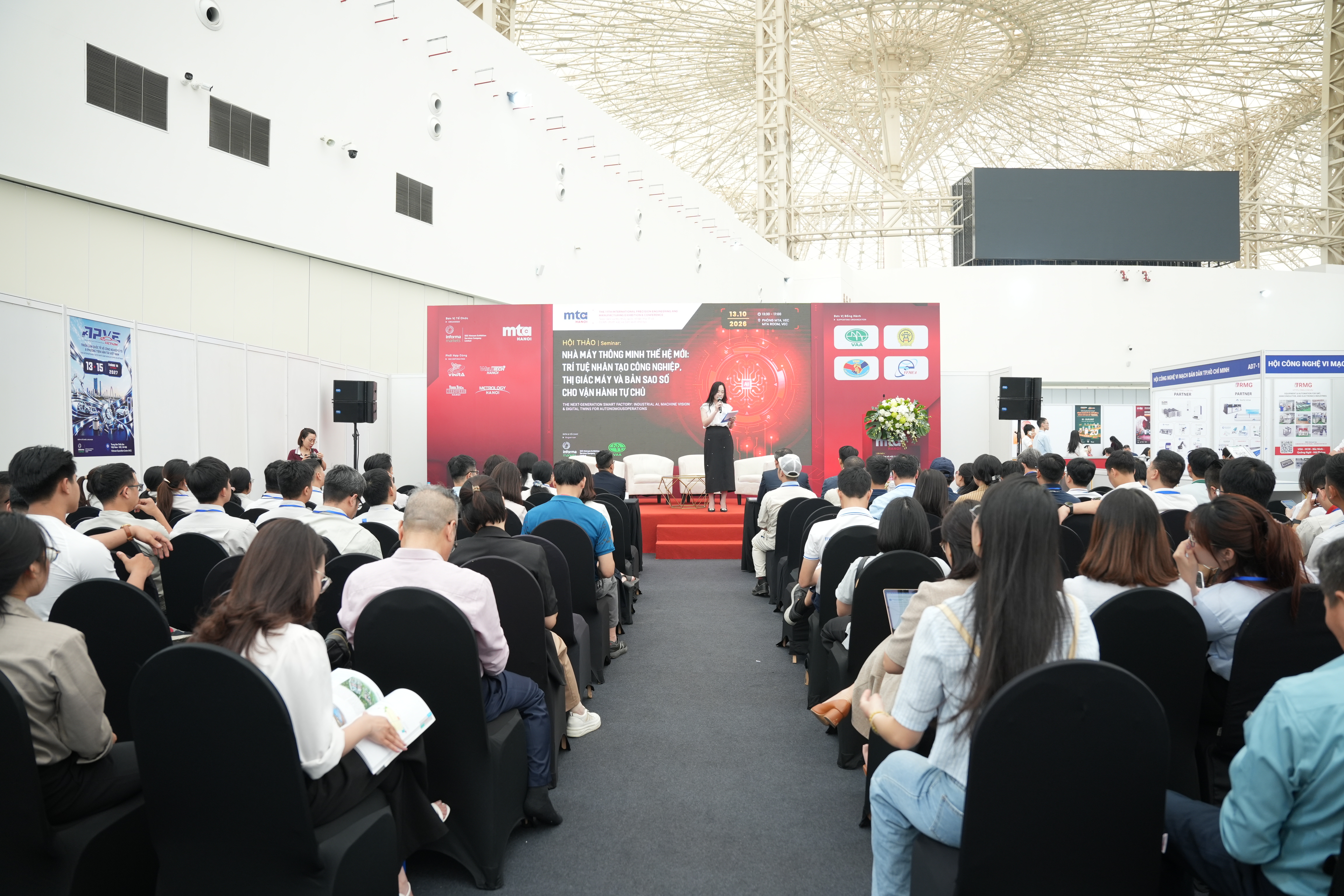
As part of MTA Hanoi 2026, ETEK participated in the seminar titled “Next-Generation Smart Factories: Industrial Artificial Intelligence, Machine Vision, and Digital Twins for Autonomous Operations” on the afternoon of October 13, 2026. The seminar provided insights into emerging technology trends in manufacturing, highlighting their role in accelerating digital transformation, optimizing operations, and advancing the development of smart factories.

1. ETEK Participates in the Next-Generation Smart Factory Seminar at MTA Hanoi 2026
On the afternoon of October 13, 2026, as part of MTA Hanoi 2026, ETEK participated in the seminar titled “Next-Generation Smart Factories: Industrial Artificial Intelligence, Machine Vision, and Digital Twins for Autonomous Operations.”
The event provided an opportunity for experts and businesses to exchange perspectives on technology trends shaping the future of manufacturing, particularly the application of Industrial Artificial Intelligence (Industrial AI), Machine Vision, and Digital Twins in factory operations.
Through practical insights and professional discussions, the seminar highlighted the role of advanced technologies in manufacturing digital transformation, paving the way for smart factories with enhanced monitoring, control, and operational optimization capabilities.

2. Three Key Technology Trends Driving Next-Generation Smart Factories
The advancement of digital technologies is creating new opportunities for manufacturers to enhance their production capabilities. Among these developments, Industrial AI, Machine Vision, and Digital Twins are key technologies supporting automation and operational optimization.
2.1. Industrial AI – Enhancing Data Analysis and Production Optimization
Industrial Artificial Intelligence enables manufacturers to leverage production data to detect anomalies, analyze performance, and support informed operational decisions.
Applying AI in factories enhances process monitoring, helps anticipate potential issues, and improves resource utilization. It also serves as an important foundation for more proactive and flexible manufacturing operations.
2.2. Machine Vision – Supporting Automated Quality Inspection
Machine Vision is a technology that uses cameras, sensors, and image-processing algorithms to identify, inspect, and analyze the characteristics of products or objects on production lines.
When integrated into automation systems, Machine Vision can support visual inspection, defect detection, and consistent product quality control. This technology helps reduce reliance on manual inspection while improving the accuracy and efficiency of manufacturing processes.

2.3. Digital Twins – Optimizing Operations Through Simulation and Data
A Digital Twin is a digital representation of a physical object, piece of equipment, or system, supported by data and simulation techniques.
In manufacturing environments, Digital Twins can help businesses monitor equipment status, simulate processes, evaluate operational scenarios, and identify opportunities for improvement. When combined with real-time data and appropriate analytical technologies, Digital Twins provide a stronger foundation for decision-making and factory optimization.

3. From Digital Transformation to Autonomous Factory Operations
While individual technologies can deliver specific benefits, integrating Industrial AI, Machine Vision, and Digital Twins into a well-designed system enables manufacturers to progressively improve data connectivity, process monitoring, and production optimization.
Next-generation smart factories aim to operate based on data, with integrated systems that help identify issues, provide insights for decision-making, and improve operational performance over time.
To achieve effective implementation, businesses need to identify their specific requirements, assess the readiness of their infrastructure and data, and select technologies suited to their manufacturing needs. This approach provides a practical foundation for implementing digital transformation step by step while ensuring feasibility and investment effectiveness.

4. ETEK Supports Businesses in Developing Smart Factories
With experience in implementing automation and smart factory solutions, ETEK supports businesses in exploring and applying technologies to their manufacturing operations.
By understanding each business's practical needs and operational objectives, ETEK aims to provide consultation and implement suitable solutions that contribute to higher productivity, improved quality, and more efficient manufacturing processes.
ETEK's participation in the seminar at MTA Hanoi 2026 also provided an opportunity to exchange technical knowledge, stay updated on emerging technology trends, and connect with experts and businesses across the manufacturing industry.

5. ETEK at MTA Hanoi 2026 – Connecting Knowledge and Advancing Technological Innovation
The seminar, “Next-Generation Smart Factories: Industrial Artificial Intelligence, Machine Vision, and Digital Twins for Autonomous Operations,” offered valuable perspectives on the role of technology in shaping the future of manufacturing.
ETEK would like to express its sincere thanks to the organizers, experts, and participating businesses for their contributions, insights, and engaging discussions throughout the event.
Moving forward, ETEK will continue to support businesses in adopting automation and smart factory technologies, contributing to digital transformation, improved operational efficiency, and stronger competitiveness in industrial manufacturing.


_cr_480x300.png)
_cr_480x300.png)

_cr_480x300.jpg)
